
Epistemic and Aleatoric Uncertainties in Weather and Climate
Published:
Machine learning is rapidly becoming an important part of weather and climate modelling, particularly through ML-based parameterisations for unresolved atmospheric processes. By learning small-scale behaviour from high-resolution simulations, these approaches can be embedded within coarser-resolution models at much lower computational cost. However, we still lack a clear understanding of how uncertainties in ML parameterisations influence simulations across weather and climate timescales. In our paper, we aim to quantify uncertainties in ML parameterisations by source and across timescales.
Uncertainty is often categorised into two types: aleatoric uncertainty, which arises from inherent randomness or natural variability in a system, and epistemic uncertainty, which is associated with lack of knowledge and includes model uncertainty and parametric uncertainty.
To study how these uncertainties influence simulations, we use the Lorenz 1996 (L96) model, an idealized system for chaotic dynamics across timescales. We train ML parameterisations to learn the small-scale processes and embed them within a coarse, large-scale version of L96. For epistemic uncertainty, we learn uncertainties in the neural network weights/biases using a Bayesian neural network. For aleatoric uncertainty, we also learn the variability in the unresolved processes present in the training data.
We find that different uncertainties dominate at different timescales. On weather timescales, aleatoric uncertainty associated with unresolved variability has the largest impact on forecasts, while on climate timescales, epistemic uncertainty associated with the ML parameters becomes increasingly important (see Figure below).
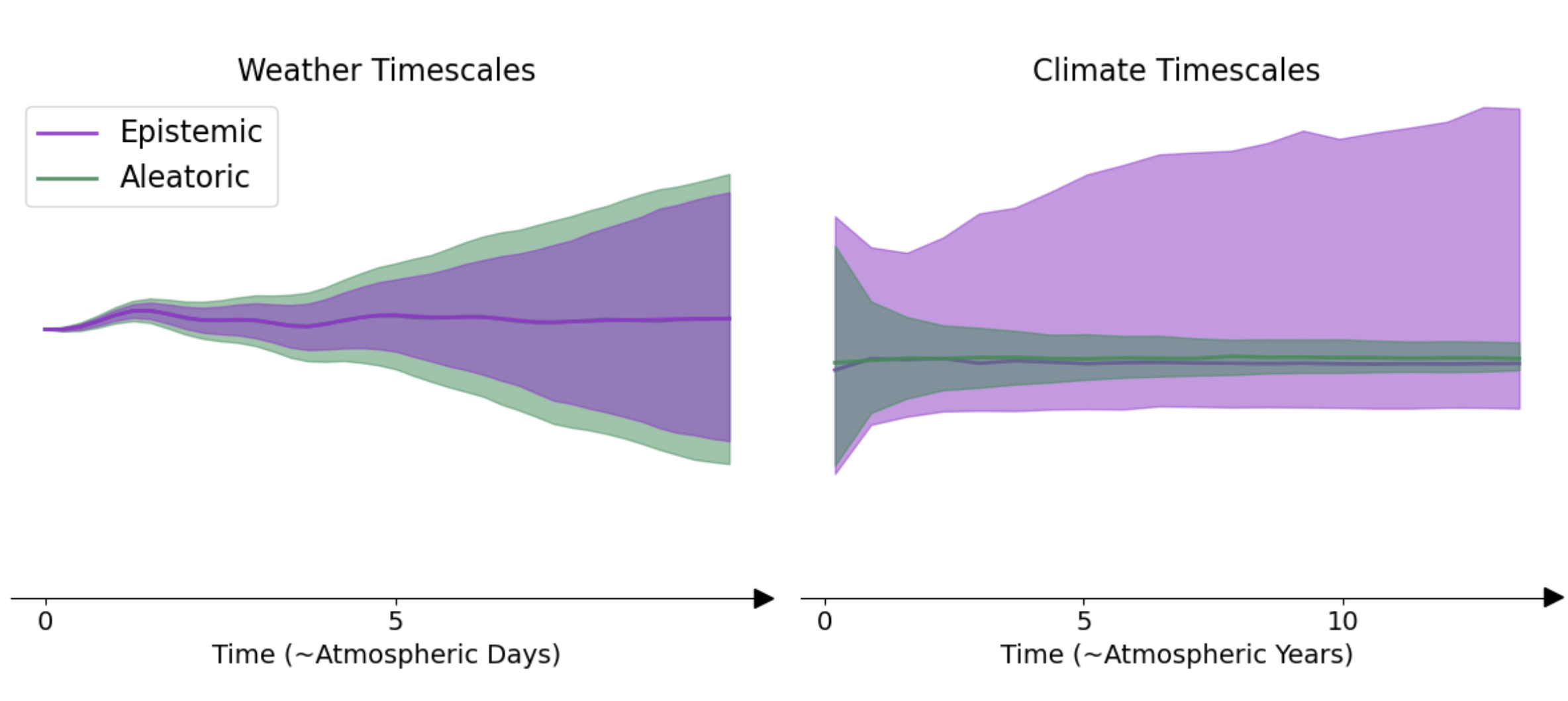
Our results also show that the way uncertainty is sampled can affect simulation behaviour, and that sampling epistemic uncertainty over longer timescales may create opportunities to better constrain model uncertainty using observations. Overall, our work highlights both the importance of uncertainty quantification in ML parameterisations and the need to tailor these approaches to the prediction timescale of interest.
Read the full paper here: https://rmets.onlinelibrary.wiley.com/doi/10.1002/qj.70219