
What is the Lorenz-96 System?
Published:
What is the Lorenz-96 System?
Before testing new ideas in weather and climate modelling, scientists often start small. The Lorenz-96 system is one of those small but powerful models. It was designed by Edward Lorenz as a simplified version of the atmosphere, capturing its most important property: chaos. Tiny changes in initial conditions can grow quickly, just like a small shift in today’s weather forecast can change tomorrow’s outcome. You may have heard of this as the butterfly effect: a flap of a butterfly’s wings can change the course of the weather halfway around the world, potentially even cascading into a hurricane.
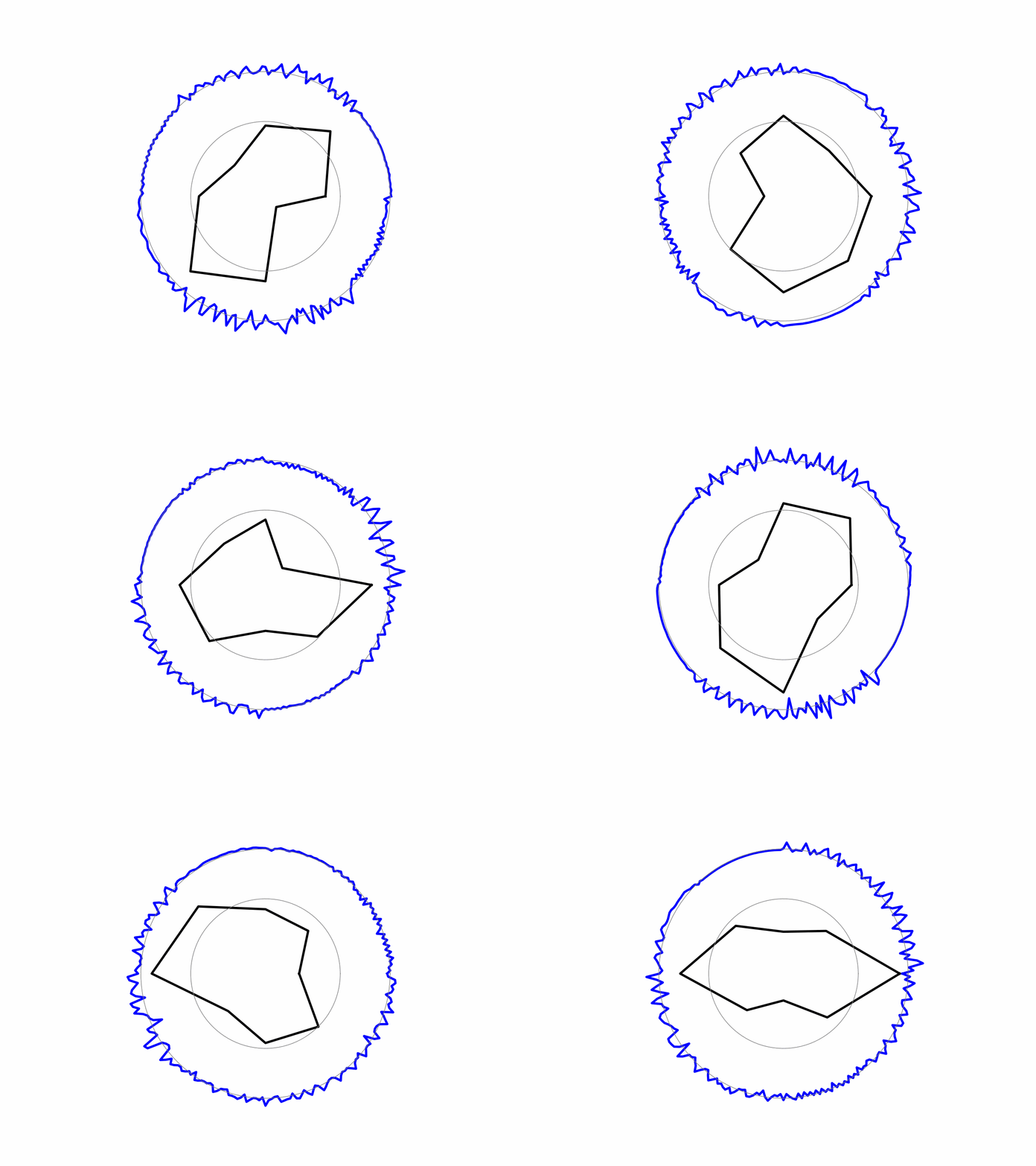
Lorenz-96 is an idealised model of advection around a latitude circle in the mid-latitudes. In Lorenz-96, a set of large-scale variables represents slow, smooth motions, like broad weather patterns or jet-stream waves. Each large-scale variable is connected to several small-scale variables, which represent fast, turbulent processes like convection or eddies. The small scales feed energy back to the large scales, constantly stirring the system. Together, they produce behaviour that looks similar to real atmospheric variability but is simple enough to compute on a laptop.
This makes Lorenz-96 an ideal testbed for experimenting with new methods. It allows us to study predictability, chaos, and uncertainty without the cost of running a full global climate model. It also makes a great toy model for testing parameterisation setups, because of the interaction between the large and small scales. In the video below, you can see the large-scale variables in black and small-scale variables in blue. The large scale variables evolve slowly over time - notice how there are waves that drift around the circle. The small scale variables show much greater variability between adjacent grid-cells, but they also show strong coupling to the large scale, almost ‘following’ the large scale variables around. This highlights the interaction between scales, a key feature of the real atmosphere.
We will use this toy model of the atmosphere to explore how uncertainties arise in weather and climate prediction and how machine learning, specifically Bayesian Neural Networks, can help represent them more realistically. This is all part of my 2025 paper on quantifying uncertainties across timescales.